

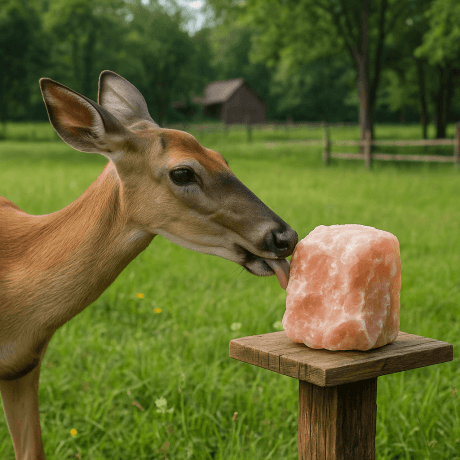
When feeding livestock, nature is the best solution; its products are clean, untreated, and pure - one of the most effective solutions in this world. Himalayan salt lick is one of such marvels. These pinkish blocks, produced by Himalayan Salt Co., are not just salt; these natural mineral deposits millions of years old, which have been buried by the Himalayan mountains, are actually a naturally balanced source of more than 80 trace minerals vital to the health and well being of animals.
However, what is the difference between the Himalayan salt licks and regular salt blocks? What is it about them that makes them a current preference of farmers across the world as a supplement of choice to their animals? So, how really special are these natural mineral blocks?
What and why Himalayan salt licks?
The Himalayan salt is not a recent invention. It is formed by a primal sea, which evaporated more than 250 million years ago in the past with the leftover mineral deposits that were pressed deeply into the Earth. They are the loci of the purest deposits of naturally occurring salt deposits that have actually ever been found on the face of the Earth, and they are located in what is now the Khewra Salt Mine in Pakistan.
Himalayan salt licks for animals unlike processed salt, which is chemically purified to extract most of the nutrients by washing in water, whereas Himalayan salt is simply hand-mined and preserved in its natural raw form. This purity, which has not been altered, makes it something of great value, particularly nowadays, when animal feeds are being administered more and more by synthetic food supplements and artificial food emissions.
Along with Sodium: A Wide Mineral Picture
The greatest number of individuals will actually attach the association of salt to sodium, and will be accurate to do so, as sodium plays a pivotal role in both hydration, as well as nerve and muscle performance. Nevertheless, the benefits of Himalayan salt licks for animals do not merely amount to providing sodium. It has more than 80 trace minerals present in it; many of them are not commonly available in one source.
These include:
Magnesium- Enhances the health of the nerves and lowers stress among animals.
Calcium builds strong bones and teeth, as well as bone development.
Potassium- It helps in energy production and fluid balance.
Zinc- Strengthens the resistance and recovery.
Iron The presence of iron is necessary for healthy oxygen and blood transportation.
Manganese, phosphorus, iodine, copper, selenium, and others are in very low yet biological amounts.
It is not the amount of each mineral but its bioavailability and natural balance that matters most; the form these minerals are found in the Himalayan salt is readily absorbed by the animal body, in contrast to most laboratory-created mineral supplements that go unused through the system.
The Way Animals Gain Using the Himalayan Salt Licks.
Similar to humans, animals also need minerals to perform literally every physiological process, including food digestion and tissue development, maintaining the immune system and reproducing.
When Himalayan salt licks are available to animals, the results usually speak for themselves:
Better feed consumption:
Sodium enhances the appetite and makes the fibrous feed easy to consume.
Improved hydration:
Himalayan salt licks for animlas make animals consume more water, which is essential in the metabolism function and milk production.
Healthier skin and coats:
The trace minerals also help healthy skin and coat shine, horn quality, and hoof health.
Reproductive ability:
Fertility and reproductive performance can be increased in many situations when the animals benefit from minerals their body was lacking.
Natural cleansing:
The mineral level may help the livers and kidneys efficiently flush the toxins.
Improved behavior:
Mud, sticks, stones etc. are chewed by mineral deficient animals. These habits can be checked with the help of the Himalayan salt.
Not a mass-manufactured product; it is a Natural Supplement.
The Himalayan salt lick is one of the reasons why it is gaining popularity since it is not produced in a laboratory. Unlike the standard mineral block, which is generally pressed combinations of salt, synthetic minerals, molasses, and chemical binders, Himalayan salt licks are cut out of rock and, therefore, do not include:
Preservatives
Binders or fillers
Artificial colors or flavors
Chemical additives
This is why they are the perfect option when it comes to organic farms, free-range and all organic animal operations that has the emphasis on natural and sustained animal health.
Can be Adapted to a Wide Variety of Species
Himalayan salt licks can be used with a broad variety of domestic and wild animals. They are suitable to fit in stalls, pastures, or feeding stations and may be used all year round. Examples of some of the benefiting animals are:
Cattle farming:
Salt is used in the rumen, milk production, and bodybuilding of dairy and beef cows.
Sheep and Goats sheep and goats are already susceptible to trace mineral deficiencies and the balanced availability of zinc, copper and selenium produces benefits.
Horses need Himalayan salt licks to control the amount of sweat lost, particularly in heavy work and hot climates.
Salt is particularly important to horses because of the sweating from the heavy work and hot climate.
Wildlife:
Naturally, salt attracts deer, antelope, and elk, members of the wild ungulate family and a mineral resource necessary for their development and well-being during migration.
Long-Lived, Good Labourer
The Himalayan salt licks are not only healthy but also cost-effective and weatherproof. They are so hard-structured that:
Better duration as compared to conventional blocks
Do not fade away in rain or moisture.
When licked repeatedly, it does not crumble nor disintegrate.
Non-contamination by bacteria and soil
What to Be Aware of
As much as it is incredibly helpful, Himalayan salt licks for animals should be used responsibly. Some of them are:
Always have fresh water close at hand; salt produces thirst, and dehydration can prove fatal.
Start them off slowly. New animals using salt licks will overeat at the start.
Sheep are very sensitive to excess copper so if unsure, contact your vet or use one of the commercial sheep specific design salt blocks.
Store them dry and off ground when not in use so as not to contaminate them.
Conclusion:
In a world of farming that so often falls prey to convoluting chemical feeding kickstarts and cost prohibiting nutritional inserts, the Himalayan salt lick takes the cake of being something as simple as it is complex: mineral rich Himalayan salt licks, cut out of the Earth, and able to restore, support and uphold animal health through its natural properties to no end, with absolutely no additives or artificial supplements.
It is no miracle product, it is a portion of the mineral wisdom of the Earth, and it is swallowed by nature-friends with all the rest of the charge as nature meant it. In the case that livestock can access the Himalayan salt freely, they maintain balance by licking the salt only as much as necessary, and intuitively by instinct. It results in more healthy, better equipped animals and a better, even farm, with time.